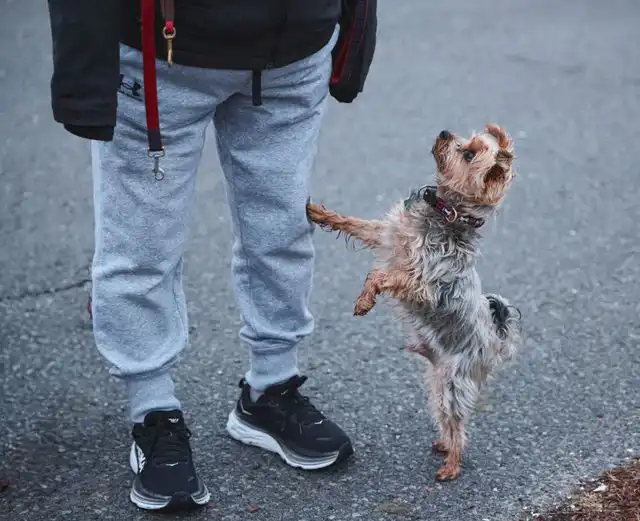
Jumping up to greet humans is one of those traits that was cute when your dog was a tiny bundle of fluff, but once your teenage dog has grown it’s often less welcome!
But hey guess what … it’s one of those behaviours that we inadvertently encourage, so we need to check what we’re doing so we don’t reinforce the behaviour, making it harder to modify.
Whether we are encouraging our teenage dog that jumping up is okay by responding to their over enthusiastic greeting; or we’re telling them off for doing it we are reinforcing their behaviour.
Even more confusing to our teenage dog is that we encouraged them in jumping up when they were small cute puppies, but now we’re saying they should not do it. “What is it you want hoooman?” you can sometimes see your dog is thinking!
Why Jumping Up is a Common Behaviour in Teenage Dogs
- Excitement – whether it’s when you return home or a visitor arrives, it’s a joyful occasion for the dog and this means they want to celebrate. They can barely contain their excitement;
- Natural Behaviour – there’s an evolutionary aspect to dogs jumping up. As the mother would have left her litter to seek food. When she returned the pups would enthusiastically jump and lick her to stimulate an involuntary reflex to regurgitate food.
- Greeting – dogs greet each other by sniffing faces (yes and butts!). They are not tall enough to reach our faces, jumping up is a way of getting much closer;
- Attention Seeking – jumping up has previously been rewarded by attention so this makes it more likely the dog will do it again.
- Anxiety – dogs will jump up to seek reassurance from their owners if they feel threatened. Your dog may almost climb up your leg and appear to hide from the perceived threat.
- Overstimulation – dogs will often jump up and put their paws on a barrier to if their movement is restricted.
Reasons why we might want to stop teenage dogs from jumping up
- Dangerous – a dog jumping up on someone who is infirm could result in a loss of balance and cause a fall; or jumping up on a child could push the child over.
- Not everyone loves dogs – (hard to believe I know!) a dog jumping up on someone who is anxious around dogs could be really scary for them.
- Annoying – a friend is visiting and walks in the door wearing a really lovely outfit, she’s not necessarily going to thank you if it’s covered in paw marks!
- Over arousal – responding positively to your teenage dog jumping up, may simply make the dog more excited and unable to self-regulate.
Regardless of your personal feelings about your dog jumping up to greet you, it’s far safer to address this and teach your teenage dog alternative behaviours to jumping up. But this is one thing where you will need all the family and anyone interacting with the dog to be consistent.
Consistency is important for all behaviour modification and training, but especially for helping a dog to learn that jumping up is not the best way to greet someone and solicit attention.
Rather than teach a dog not to jump up, the first step is to decide what behaviour you want instead.
This may vary slightly depending on where the dog is jumping up – inside the house or when out on walks. You may need a slightly different strategy that works for different environments but achieves the same results. For dogs who are anxious it is also a slightly different approach, as the primary need is to make them feel safe.
Many trainers will recommend teaching an alternative behaviour such as a sit, which is great as sitting is incompatible with jumping up. However, your teenage dog’s over-busy stimulated brain may not be able to cope with this strategy. It means your dog must turn off its emotional brain and turning on its logical brain, not easy to do when it’s already excited.
I’m not suggesting that all dogs will struggle with this, providing there is a lot of training and consistency, but it may be easier to use something else that the dog finds rewarding.
It’s also important to bear in mind the reason your dog is jumping up. If it’s a reaction because it’s anxious, it will be hard for the dog, not to mention unfair to make it sit.
What Can You Teach As An Alternative Behaviour to Jumping Up
Sit
While I’ve this isn’t necessarily the best behaviour, it may be right for some occasions and your dog may find it rewarding if it sits and is given lots of treats for doing so. It can also be an easy one for all family members to remember and teach.
Down
A similar principle to a sit and to some dogs a down comes more easily than a sit. Equally some dogs may find it harder to lie down than sit. It’s important that you chose a behaviour the dog finds easy
Touch
Nose touch to your hand is a great way of making a connection with your teenage dog. They get reinforced for making contact with you but also for keeping four paws on the ground. It can also be used for dogs who are anxious and help them to change their mindset from anxiety to being able to task orientate themselves.
Middle
For anxious teenage dogs, middle represents a reassuring place to be, between its care givers legs. Many dogs find it self-reinforcing to get into the middle position and it does mean that owners can feed and reward the dog for staying in a middle position. This is particularly useful to use when you are out and about and your anxious dog wants to climb your legs to safety.
Four Paws on the Ground
This can mean a sit, down or stand but basically keeping all four paws on the ground. If your dog can manage a stand then you could also scatter feed around the dog to keep them occupied either inside or outside the house. If you’re going to do this the treats will need to be high value.
Settle
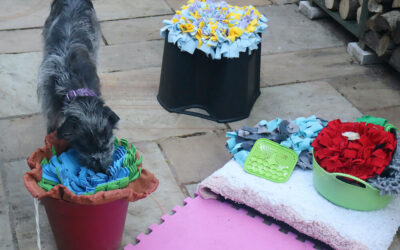
This can be effective in the house to prepare for visitors or other household members coming into the house; but is less easily managed when you’re outside. You want the bed or settle mat to be intrinsically rewarding for your dog. If your dog already knows how to relax on a settle mat then great, otherwise you want to work on this by pairing the mat with high value food rewards. You could also set up a Free Work station for your dog to enjoy on its settle mat.
Visitors Role
Whatever behaviour you chose you need to get buy in from all household members and anyone responsible in the care of your dog – anyone who is coming into the house; walking the dog or letting visitors into the house.
You may also need to ask visitors to help you be consistent. If you’re struggling with people interacting with your dog out on walks, then getting your dog a harness or lead that says “in training” or “I need space” may help. You may also need a firm voice, as it’s not unusual for the local ‘dog whisperers’ to think they don’t need to abide by these guidelines!
Management Strategies
As with any training you need to start slowly and build up. If you’re expecting a house full of guests next weekend, you’re not really giving yourself or your teenage dog a chance if you only start the week before!
If you are in that situation you would be best to employ management strategies. I would recommend that you or a member of the household takes your teenage dog into a different room and plays with it (puzzle games can be good for this type of distraction) while your guests arrive. When people have settled you may ask your guests to ignore the dog if it’s brought into the room.
Training Tips
If you’re able to start training without an issue such as a house full of guests arriving imminently, start slowly. Decide on the behaviour you want and if this will be the same in the house and outside. If you are using different behaviours make sure these are agreed between family members. I know I’m getting boring on this point but it really is important!
You want to train the behaviour you want. Make it extremely reliable in a calm and quiet environment before you add distractions (people, environmental factors). Do not skip this part – even though it might not seem it’s directly fixing the problem.
Reward, reward, reward the dog for making the right choices. You can fade food rewards at a later stage, for the moment you want the dog to know it’s getting paid and this is the best thing ever! Wow all it needs to do is a sit or hand touch and food magically appears every time!
Use a marker, like a verbal cue or clicker, to reinforce desired dog behaviour immediately before rewarding. The sequence should be verbal cue, click or marker, then reward. Additionally, teach a release word such as “free” to indicate when the dog can move, initially pairing it with a treat to maintain motivation. Clickers are helpful for this type of training – if you’ve not used one before check out below how to start.
If you’re new to clicker training don’t worry there’s a paragraph below explaining the basic principle.
Training is Never Linear
Once you’re happy you have a solid behaviour, it’s time to add in distractions, initially, in the home environment. This will help you prepare for using it as an alternative to jumping up when greeting people.
Ask family members to come in, ignore the dog and practise the behaviour you have chosen. Start by being at a distance from the door with your dog and gradually move closer. Short training sessions are best.
If you’re struggling to introduce people it may be that the behaviour is not sufficiently fluent or the rewards may need to increase in value. While you might find that your dog quite happily does a nose touch for a piece of kibble when it’s just you and your dog, add in fun Dad walking into the room and you may need to graduate to chicken or cheese!
If it feels like one step forward and two backwards – don’t despair. Simply go back to doing a few short sessions of just asking for and reinforcing the behaviour before trying again. Dog training is never linear.
You’re working with a sentient being not a machine. We all have days when we’re on top of our game and others when we are not so switched on. Celebrate the wins and use the less successful attempts to see if you can work out what went wrong.
Once you’ve successfully practised the behaviour with family members, try introducing people who visit the house. Make sure they are given clear instructions to ignore the dog and to simply come into the house calmly.
One thing you can do to make life easier is have your dog on a lead or long line (that no one can trip over!) so you may feel you have a bit more control.
What To Do With Visitors While You Proof Your Dog!
While you’re getting to the stage that people can enter the house easily and without being jumped over, you will need to have a management plan in place to stop your dog from rehearsing their jumping up behaviour. The best approach is to make sure everyone who comes in ignores your dog unless they are keeping four paws on the ground. They also need to know what to do if your dog starts to jump and you cannot distract it in time.
The moment their front paws start to lift, shift away and turn ninety degrees away. Try not to say anything – I know just how hard this can be – but you are simply reinforcing the behaviour and giving your dog attention its craving, by doing this even if it’s simply to tell it to get down. This will slow down the success of your training.
Once you’ve mastered this indoors, it’s time to start working on this when you’re outside. If you’re not using the same behaviour in an outdoors setting, you will need to start from the beginning and train the behaviour to be really fluent inside the home before taking it outside. Once you move outside work in an area with minimal distractions before attempting to introducing other people.
Note About Clicker Training
This is another topic in its own right, but the basic principle is you use a clicker instead of your marker word (good, yes or whatever you prefer). The theory is that the immediacy of the clicker is more likely to create the association in the dog’s brain that it’s done something right.
Before using a clicker for the first time you will need to pair the clicker. This means your dog understands that click means a treat is on its way. You set yourself up with a clicker and a pile of say 10-20 small treats. Click and give the dog a treat. Do this for a few repetitions. Then wait for the dog to look at you to work out when it’s going to get paid – click and give treat, continue for a few more reps. Once you’ve paired the clicker you can use it for many different training exercises.
When I was first introduced to clicker training, I really didn’t get it. I thought that I had to learn a gazillion different click sequences to represent different behaviours before realising the clicker simply replaced the marker! – I can be a slow learner!
Hopefully these tips will help you with a teenage dog who is jumping up, I’d love to know how you get on. But if you’re still struggling please do not hesitate to get in touch.