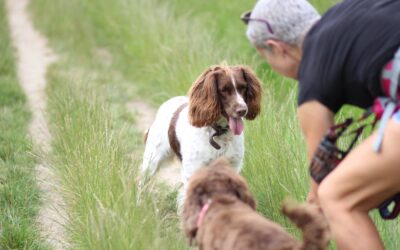
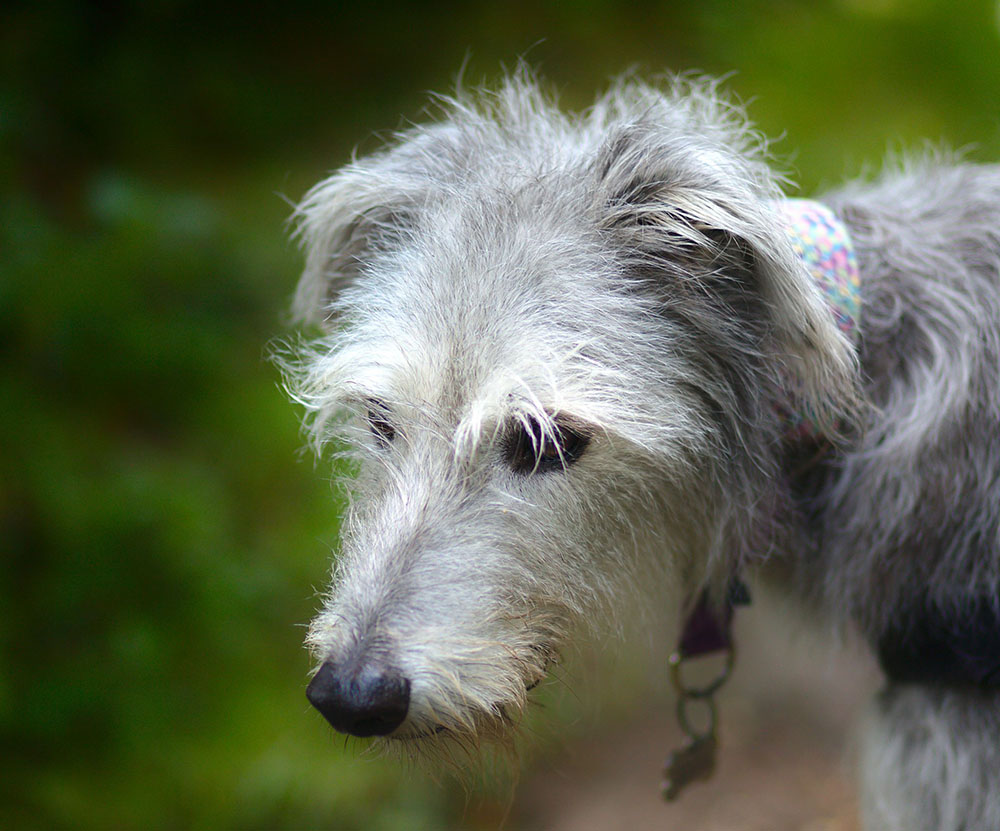
Our second dog Herbie taught me so much about dealing with reactivity. Our nightmares began when as a puppy he pulled me over on a busy road because he reacted to a white van going past.
When he was about 18 months, he started to become reactive towards people and dogs. It was intermittent and there was no obvious pattern. We believed it was down to a lack of socialisation as a puppy (we rescued him at 6 months) and adolescence.
The scariest thing was when I ended up in hospital being treated for sepsis. Herbie’s red mist descended when he saw a cat while on lead and my leg happened to be in the wrong place as I held him back.
I have the scars and experience of dealing with a reactive dog, who now he’s 14 is a gentle loving boy! Did I always get it right – no! If we got into a situation where he reacted, I would get really angry – not with Herbie – but with myself. I’d let him down. But I had to keep learning from these experiences to become a better dog owner and guardian.
The one thing I wish I’d known was the impact of hypothyroidism on behaviour.
Perhaps It’s Medical
Herbie was diagnosed with an underactive thyroid when he was about 9. For years it’s been thought that middle aged dogs are most at risk. Thyroid condition and is normally tested for when the classic symptoms of weight gain and hair loss start to show.
But the research I’ve done concludes hypothyroidism often starts in dogs as young as 18 months. Also that unexplained reactivity and behaviour changes can appear a long time before physical symptoms.
While I’m not suggesting that every reactive dog has a thyroid problem, it’s a very simple thing to rule out and can be done via a blood test. If diagnosed your vet will prescribe L-thyroxine (which will be needed for the rest of the dog’s life).
If a behaviour starts occurring for no obvious reason it’s always sensible to make sure your dog is not in pain or suffering from a health condition that could be impacting his behaviour.
Is It In The Genes?
While a dog might appear bold and confident as it’s lunging and snarling at something, chances are it’s not. The dog is probably acting out of fear.
While it won’t help in the moment your dog turns from Dr Jekyll into Mr Hyde, it may help you to manage your dog and to empathise with him.
Fear may have arisen from genetics, lack of socialisation, a frightening experience or more likely a combination of factors.
So while you can’t do much about genetics or breed traits, you can influence the external factors to help your dog manage its fear.
Early socialisation between weeks 4 and 12 leave an indelible mark on your dog’s life. If a dog is inadequately socialised at this stage you will need to help him overcome fears he may have developed as a result.
You cannot avoid or control all frightening experiences. A dog who is noise-phobic will often react if a bird scarer goes off in a field.
It’s important to remember that behaviour is a complex interaction of internal and external factors that drive a dog’s responses to any situation.
Avoid The Triggers
As your dog’s guardian the most important thing you can do is to reduce your dog’s exposure to the stimuli that provoke reactions in your dog.
As an example, Herbie’s reactivity towards cats. We live in a quiet cul-de-sac where the local feline population love sunning themselves on the road or on top of cars. Where possible we would manage the situation by:
- checking for cats in the road before leaving the house and encouraging them to move on if their plan was enjoying a session of dog tormenting!
- always take the dogs out for a walk using the car, so the chances of meeting cats were greatly reduced
- parking the car when we came back so that Herbie couldn’t see any cats while we got him into the house!
It didn’t always work – the odd cat running across the road would set off a maelstrom of ear drum busting barking, at the very least.
So how else should you manage a reactive dog?
Flooding – Don’t Be Tempted!
A controversial method of overcoming fears and phobias, that has been used as therapy for both humans and animals, is called flooding. The concept is to expose the person or animal to their fear as much as possible and the rational is they realise there is nothing to worry about and become less stressed.
So if a dog reacts negatively to other dogs, you would expose him in a situation to meeting as many other dogs as possible in an enclosed environment.
Flooding has a high failure rate and is more likely to make a dog more anxious and to adopt other coping mechanisms such as aggression or shutting down and completely withdrawing.
I’m petrified of jellyfish. One year on holiday I unwittingly swum into a brood of jellyfish and I can attest that flooding does not work. Not only was I stung all over, as I swum back to shore screaming like a banshee, but my fear of them now is greater than ever.
The Yummiest Treats
Desensitising and counter-conditioning offer a safe and positive way to help a reactive dog overcome its fears.
The first step is to desensitise your dog. Show him that he can be in the same space as something he fears and nothing bad will happen. In fact only good things will happen to him. Arm yourself with the yummiest high-value treats.
Then let’s use the example that your dog struggles when he meets another dog on lead when you’re out for a walk.
You end up with a pulling, lunging bark-fest every time you pass another dog on lead, or maybe it’s only some dogs, but try as you might, you can’t work out which ones.
This is a really common problem. Some dogs get very anxious about meeting other dogs when on lead, there’s no escape if it gets scary, so they react.
The first thing you need to do is work out your dog’s threshold. Sure meeting in an alleyway or on a narrow path is likely to trigger a reaction. But in a park or field you should be able to get far enough away that your dog won’t react when another dog passes. Keep feeding your dog treats in the presence of other dogs.
Gradually get closer to other dogs and see if you can reduce the threshold. If it doesn’t work, move out again until he’s ready to get closer.
What Do You Want Instead?
Decide what you want your dog to do when he meets other dogs.
Ultimately, I’m sure you want him to be able to greet them and say a polite hello. This is a great goal to have but do not try to rush it. You need to get your dog comfortable and non-reactive around other dogs first.
So initially try to get your dog to do a nice sit and reward him for that in the presence of other dogs. This is the counter-conditioning element and one step on from simply handing out the treats when he’s in the vicinity of another dog.
Praise him for staying calm and not reacting.
Your dog will gradually learn to become less fearful and more confident around other dogs.
Don’t get disheartened if your dog doesn’t seem to be improving, but instead consider how you might make it easier for him and set him up for success. Maybe you’re going too fast and expecting too much. This is a challenging behaviour to overcome because it involves other dogs as well and how they react to your dog, rather than something you can control. Perhaps you can illicit the help from friends who have dogs who are generally calm around other dogs on lead.
Finally
As with all training we want to make it a positive and rewarding experience for you and your dog. Enjoy spending quality time together and celebrate your wins.
If you’re interested in finding out more about how I can help you CONTACT ME.
Remember this will take time and you may have setbacks. Don’t get discouraged and always take training back a step and start again. Remember you want to set your dog up for success.