The Science Behind Adolescent Dog Behaviour
Hormone changes in teenage dogs can have a radical impact on your previously good and chilled out puppy!
Has your perfectly behaved puppy suddenly developed selective hearing? Have they forgotten their recall, become more reactive or seem incapable of switching off?
If so, you’re not alone.
Living with a teenage dog can feel like an emotional rollercoaster. One day they’re calm and affectionate, the next they’re bouncing off the walls, barking at absolutely nothing and apparently ignoring everything you’ve ever taught them.
Many owners are told their dog is simply “testing boundaries” or “being stubborn”, but the science tells a rather different story.
Canine adolescence is one of the most significant developmental periods in your dog’s life. During this time, enormous hormonal, neurological and emotional changes are taking place. Understanding what is happening inside your dog’s body and brain can help reduce our frustration and replace it with empathy. It can also help us to support them through this sometimes, challenging, stage of life.
What Happens During Canine Adolescence?
Adolescence usually begins between six and twelve months of age and can continue until 18-24 months or even longer in larger breeds.
During this period your dog isn’t simply growing physically. Their:
- Brain is developing.
- Hormones changes in teenage dogs are massive.
- Emotional responses are maturing.
- Social preferences are evolving.
- Ability to regulate impulses is still developing.
- Sensitivity to their environment is increasing.
Scientists now describe puberty as a “second sensitive period” because of the enormous amount of neurological and behavioural development taking place.
In other words, your teenage dog isn’t simply becoming bigger—they’re becoming an adult.
The Science Behind Hormone Changes in Teenage Dogs
Puberty begins when the brain activates what scientists call the Hypothalamic-Pituitary-Gonadal (HPG) Axis. Whilst that sounds rather complicated, it’s simply the communication system between the brain and the reproductive organs. It is sometimes referred to as the dog is reaching sexual maturity.
The process works like this: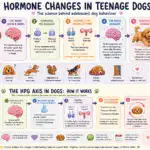
- The brain signals that puberty should begin.
- Hormones are released that stimulate the ovaries or testes.
- Testosterone, oestrogen and progesterone levels begin to rise.
- Significant changes simultaneously occur within the developing brain.
What’s particularly fascinating is that hormone changes in teenage dogs don’t simply influence reproduction—they also affect behaviour, emotional responses and learning.
Your teenage dog’s body and brain are developing together.
Why Has My Teenage Dog Stopped Listening?
One of the most common things owners tell me is:
“He knows what I’ve asked him to do. He’s just ignoring me!”
Whilst it can certainly feel personal at times, research suggests something rather different may be happening.
A fascinating study by Lucy Asher and colleagues (2020) found that adolescent dogs demonstrated a temporary reduction in responsiveness to commands given by their owners during puberty. Interestingly, this effect was not seen to the same extent when instructions came from strangers. So if your dog trainer is still being successful with your dog in classes and your dog is not responding to you, don’t get upset.
The dogs hadn’t forgotten their training.
Their brains were simply undergoing substantial developmental changes.
This may explain why adolescent dogs often appear to:
- Ignore previously learned cues.
- Have poor recall.
- Become easily distracted.
- Lose concentration quickly.
- Struggle with impulse control.
- Become increasingly independent.
If this sounds familiar, take comfort in knowing that canine adolescence is temporary—but it does require a great deal of patience, understanding and realistic expectations.
What Happens to the Teenage Dog Brain?
Perhaps the biggest change during adolescence occurs within the brain itself.
The prefrontal cortex—the area responsible for decision-making, impulse control, emotional regulation and problem solving—is still developing.
Meanwhile, the emotional centres of the brain are becoming increasingly active.
This can result in:
Bigger emotions + increasing independence + greater arousal + poorer impulse control = adolescence!
Suddenly your previously sensible puppy may become:
- More excitable
- Easily frustrated
- Emotionally sensitive
- Easily distracted
- Overstimulated by everyday experiences
- More interested in squirrels than they are in you!
Sound familiar?
Why Are Teenage Dogs More Reactive?
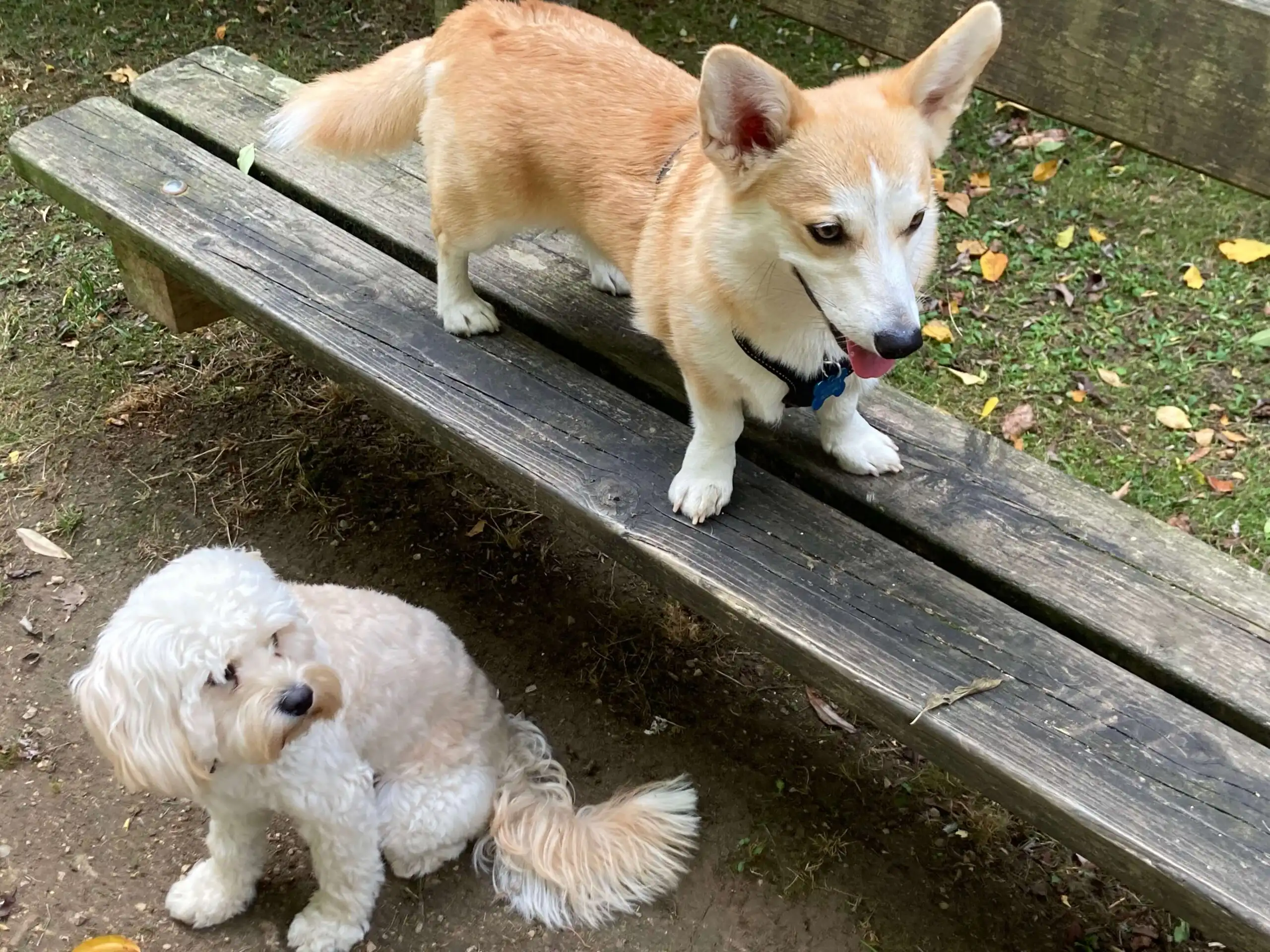
Many owners notice behavioural changes during adolescence. (Sadie and Iris playing)
Their dog may suddenly become:
- Reactive towards dogs or people
- Easily startled
- More vocal
- Frustrated on lead
- Unable to settle
- Socially selective
- Easily overwhelmed
This doesn’t necessarily mean you have a behavioural problem.
Scientists believe adolescence represents a second vulnerable period in development when dogs become increasingly aware of both their social and physical environments.
Combine this with:
- Hormonal changes in teenage dogs
- Increasing independence
- Poorer impulse control
- Sleep deprivation
- Emotional development
- Fear periods
- Environmental sensitivities
and it’s easy to see why some adolescent dogs find everyday life challenging.
Does Testosterone Cause Aggression?
Testosterone is frequently blamed for everything from poor recall to aggression.
The reality is considerably more complicated.
Testosterone may contribute towards:
- Increased confidence
- Risk-taking behaviour
- Increased interest in the environment
- Urine marking
- Mounting behaviour
- Changes in social preferences
- Increased independence
However, hormones alone do not cause aggression.
Behaviour is influenced by many different factors including:
- Genetics
- Previous experiences
- Learning history
- Pain
- Sleep quality
- Emotional wellbeing
- Environmental factors
- Individual temperament
There is rarely a single explanation for behaviour.
What About Female Dogs?
Female dogs experience equally dramatic hormonal changes during adolescence.
Increasing concentrations of oestrogen, progesterone and prolactin can influence:
- Emotional responses

- Sleep
- Appetite
- Social preferences
- Sensitivity to environmental stimuli
- Confidence levels
- Behaviour during seasons
Owners may notice their adolescent dog becoming:
- More clingy
- More independent
- Restless
- Less interested in food
- More vocal
- Less able to settle
Again, these changes are often entirely normal components of development.
The Teenage Brain Loves Adventure
Did you know that adolescent mammals experience changes within their dopamine systems that make them more motivated by:
- Novelty

- Exploration
- Rewards
- Social interactions (3 blondies playing)
- Risk-taking behaviours?
From an evolutionary perspective this makes perfect sense.
If adolescent animals simply remained attached to their parents, they would never leave home, explore, be able to fend for themselves or reproduce.
Canine adolescence encourages:
- Learning
- Exploration
- Independence
- Social development
- Adaptability
So, if your teenage dog appears far more interested in following an exciting scent than practising their recall, they’re behaving remarkably like a teenager—just not necessarily in the way we might like!
What Does This Mean for Owners?
Understanding the science changes how we interpret behaviour. Hormone changes in teenage dogs deserve our compassion and understanding as we navigate this phase of our dog’s development
Instead of asking:
“How do I stop my teenage dog behaving like this?”
Perhaps we should ask:
“How can I best support my dog whilst they’re becoming an adult?”
During adolescence, many dogs benefit from:
- More sleep
- Appropriate exercise
- Mental enrichment
- Predictable routines
- Opportunities for choice making
- Reward-based training
- Lower expectations when appropriate
- Plenty of patience and consistency
Teenage dogs don’t need harsher training methods. More often than not, they simply need understanding, support and time.
They may benefit from going back to basics in training, keeping training sessions short and fun. Don’t engage in endless repetitions of behaviour until they ‘get it’. If something isn’t working in a training session, simply stop doing it that day and try again tomorrow. Revisit what they find motivating and valuable in terms of rewards.
Above all ensure that training is fun. Dogs love to learn and it’s very rewarding for both them and us when they succeed.
Helping Your Teenage Dog Thrive
Canine adolescence isn’t simply a phase of “bad behaviour”. It represents profound hormonal, neurological and emotional development.
Your dog’s brain is being remodelled. Hormone changes in teenage dogs have an enormous effect on them. Their social preferences are evolving and their ability to regulate their emotions is still developing.
Understanding this doesn’t excuse undesirable behaviour, but it does help us approach it with greater empathy and realistic expectations.
The teenage dog bouncing off the walls, forgetting their recall or suddenly finding life overwhelming isn’t trying to make your life difficult. More often than not, they’re simply trying to make sense of theirs.
And perhaps that’s one of the most important things to remember about adolescence—it isn’t something to be “got through”. It is one of the most important developmental stages of your dog’s life and a wonderful opportunity to help them become a happy, confident and resilient adult.
By understanding hormone changes in teenage dogs, we can foster better communication and trust
Ready to Support Your Teenage Dog?
If you’re struggling with an adolescent dog who seems to have forgotten everything they’ve ever learned, you’re certainly not alone.
Together, we can create a personalised plan that supports your dog’s physical, emotional and behavioural development—helping both of you not only survive adolescence but truly thrive through it.