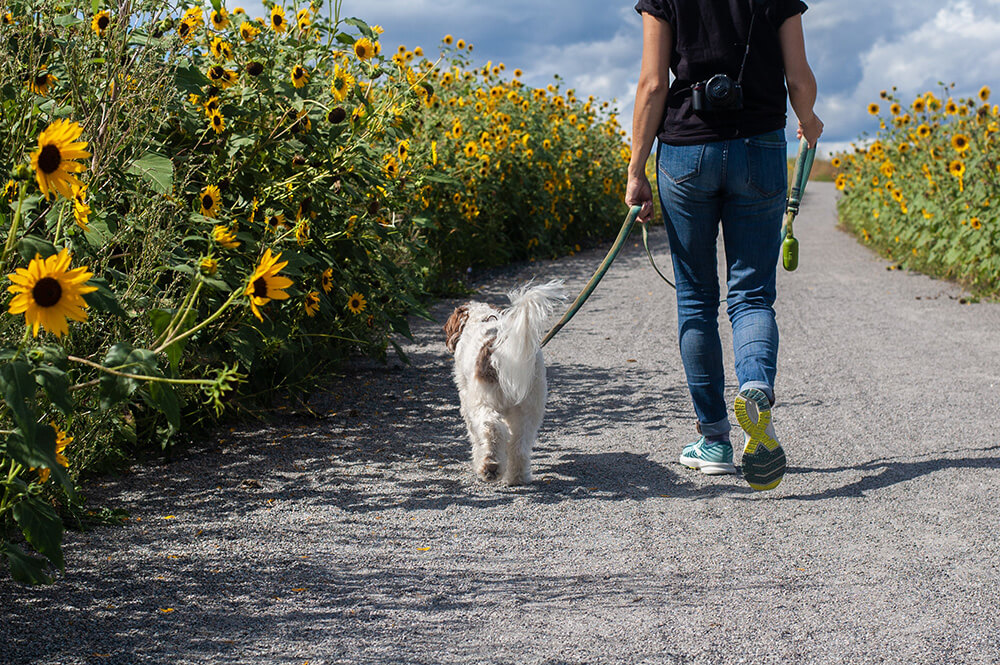
Do you stare enviously at dogs walking calmly on lead, as your puppy attempts to win an Olympic sled pulling contest? Some owners find it easy training a puppy to walk on a leash when they are very young. But then your puppy reaches adolescence and all learning seems to go out of the window. Others find training a puppy to walk on a leash is incredibly hard even from a young age.
According to the 2020 Paws Report the behaviour most owners want to change in their dogs is lead pulling! So don’t worry you’re not alone.
The problems with leash pulling are:
- You’re faced with it every time you take your puppy out for a walk;
- Even the least self-conscious owners may start to feel others are judging them;
- You resort to equipment considered aversive that may hurt your puppy.
The good news is that training a puppy to walk on a leash is possible if you follow this simple guide:
Start with the right equipment
A well-fitted harness with an attachment ring on both the chest and back will give you the best control.
Check the manufacturers guidelines and measure your puppy before you buy, so you get the right size. For your own sanity, buy a harness that is easy to put on and take off, I speak from the pain of experience as a home boarder!
In terms of lead I favour the 2-metre nylon webbing lead with 2 trigger clips that can be attached to the chest and back.
Do not purchase: a head collar, a slip lead or a choke chain. All of these are aversive, do not teach your dog about not pulling and can cause injury. A slip lead has a place in gun dog training but this is a specialist activity and is not recommended for normal walking. Equally a flexi lead or long line should not be used for training a puppy to walk on a leash.
Start training with minimal distractions
Your puppy is going to be super excited whenever they leave the house. Lots of new smells, new dogs and people to meet. Walks are amazing and they can’t wait to get started.
So you stand zero chance of teaching a puppy to be calm on lead if you’re only going to practise on a walk.
Your puppy needs to learn from you in a place with minimal distractions. Once you’ve mastered loose lead walking in the house, you can progress to your garden and then outside the property. But remember every time you move to new environment, it will be stimulating for your puppy.
You will also need lots of yummy high value treats. Tiny pieces of chicken, cheese or frankfurter work well. It’s easiest to have these in a treat pouch attached to your waist for all training, as timing is important for delivery. If your puppy is not food motivated a toy or praise can be used.
You and Your Puppy Need to be Present
If your mind is elsewhere, your puppy distracted, no training session is going to work.
Ensure your puppy has had a toilet break, is not too tired or over stimulated. Of course you will need your puppy to walk well on the leash in all situations, eventually, but don’t set your puppy up for failure from the start.
Keep training sessions short. Puppies have a short attention span. You want your puppy to be successful.
Even when your puppy seems to have ‘got it’ you need to keep practising. A dog that ‘mostly gets it’ is not reliable. That’s when you might find yourself dragged across a busy road to investigate a squirrel.
If your puppy is just not ‘getting it’ give them a break. We all have good and bad days. Consider whether you’re making it too hard for them, have not got the timing right in terms of rewards or being consistent enough for them to understand.
Get Your Puppy’s Attention
Without your puppy giving their full focus on you, any training is difficult. So you need to have their attention. You also need to be able to recover it when they get distracted.
Teaching a voluntary ‘close’ (to me) will help to get and regain your puppy’s attention.
Start this exercise by simply rewarding your dog whenever they are close to you. Do this round the house and garden at various points during the day as you are moving about in short sessions (2-3 minutes). Do not say anything. You simply want them to relate being close to you with a treat.
Once they’ve got this start marking them coming close by saying ‘yes’ or ‘good’. Keep practising this before adding the cue.
The next step is the dog comes close to you, you offer command ‘close’, then mark and treat. You are associating the cue with the activity. Keep practising and then add in distractions, such as doing on a walk.
Loose Lead Walking Stage 1
You are ready to start training loose lead walking. Points 1-4 may all seem really obvious but they set the foundation for teaching this important skill.
The plan is to interrupt our puppy before they start to pull and that’s why you need minimum distractions initially.
Start with your puppy on the lead – if it’s easier only have the lead attached to the back of the harness (rather than to the chest as well). Whatever feels comfortable.
Take one step forward and as your puppy moves forward with you, reward and mark by saying ‘yes’ or ‘good’.
Take another step and repeat. Continue this exercise one step at a time. If your puppy starts to pull ahead stop. Don’t say anything. See if they check in with you.
If they do, encourage them back to your side (you can cue ‘close’). Once they are back by your side start again.
For puppies standing at the end of the leash, try the TT touch technique of stroking the lead to reduce tension.
Next Steps
Once you have a reliable step and reward, it’s time to reduce the number of times you reward the behaviour.
Increase the number of steps between rewarding and marking (saying either yes or good). If your puppy starts pulling again then return to more frequent rewards until you have a higher success rate.
Remember each dog is an individual and will learn at a different rate.
Then you need to start practising in different locations. But remember you may need to initially increase rewards in new locations, as distractions increase your puppy’s attention span decreases.
If your puppy is still pulling think about your own actions. Are you reinforcing their behaviour? (This is so easily done).
- If a dog starts pulling on the lead it’s an automatic reflex to pull back to maintain your balance (opposition reflex).
- You may have reduced treats too quickly
- Check your timings – you need to reward and mark as your puppy steps forward.
Dos and Don’ts of Leash Training
Do keep training sessions short. Once you progress beyond the house and garden keep the walks to 15-20 minutes maximum. Learning and teaching loose lead walking takes a lot of mental energy and is tiring.
Do ensure that everyone who walks your puppy uses the same techniques. It will be so confusing for your puppy if different family members do not follow the same process. Consistency is key.
Don’t make every walk about training your puppy to walk on a leash. Make some walks relaxing walks off lead, or on a long line, if recall is an issue.
Don’t beat yourself up if you have a session where it’s not working. You won’t get it right every time. Being out and about with your puppy, there are a lot of factors beyond your control and distractions will happen. Just keep practising.
If you’re interested in finding out more about how I can help you CONTACT ME