
If your teenage dog is fearful, it’s important to show compassion and patience. Not supporting them can result in a dog who tends to be pessimistic and anxious throughout its adult life.
Puppies can experience two fear periods before they become an adult. The first occurs when they are young puppies and the second can arise when they are between six and fourteen months of age, which just happens to be in the middle of adolescence!
Suddenly not only are they (and you) dealing with all the things that adolescence brings but you now have a dog who is exhibiting fear in certain situations. With hormones surging and magnifying everything else in your teenage dog’s life, how you handle this fear period is really important.
How Do You Know If Your Teenage Dog is Fearful?
While it might seem obvious, here are some of the behaviours you might see:
- Startle Response – your dog becomes spooked at routine noises or moving objects that its previously ignored or simply been curious about;
- Freezing – particularly on walks, even on familiar routes for no obvious reason
- Vocalising – barking or growling at people or other dogs, (familiar or unfamiliar)
- Backing away from people or other dogs, even if they have met before and nothing’s happened to cause this reaction
- Becoming unusually clingy or restless
What You Should do to Help your Teenage Dog
- Remain calm – it’s important to keep your own body language relaxed. Tension, especially on the lead will encourage your dog think there’s really something to worry about, as you’re anxious too!
- Keep your distance – do not try to reduce the distance between your dog and whatever is causing his fearful response
- Let your dog process it – allow your dog to sniff and observe, providing it is not causing an escalation of fearful behaviour

- Escalation of behaviour – turn and encourage your dog in the opposite direction with a happy sounding ‘let’s go’ – you can try to lure your teenage dog, but depending on its fear level it may not accept treats.
- Create good associations – if your dog is not escalating its behaviour and you’re at a safe distance from whatever is causing the fearful behaviour you can pair glances at the trigger with food, to create a good association. Be mindful that you will need high value treats – low value kibble is unlikely to work!
- Hit pause on training – be ready to slow down learning new things until your dog is ready. Practise familiar routines, tricks and tasks to build confidence offering lots of praise and reward. Keep sessions short.
- Keep to a routine – most dogs love routines. Keep to a safe routine that is familiar and doesn’t mean exploring new and potentially overwhelming environments.
What You Should Not Do if Your Teenage Dog is Fearful
1 Punish or Scold Your Teenage Dog
Your dog is not behaving fearfully out of choice. Nor is it on a mission to make you angry or upset, much as you might think that’s the case.
If your dog is fearful then it’s instinctive fight or flight response is activated. In simple terms the dog’s amygdala (located in the brain) sounds a warning system to the brain’s control centre (hypothalamus) that there is a threat. The logical or reasoning part of the brain (pre-frontal cortex) shuts down and the nervous system goes into survival mode.
If your dog is not responding to you when its internal alarm has sounded, this is because it literally can’t. The stress response is a survival mode. The dog’s brain is working out how to conserve energy and not waste valuable resources on things like thinking, learning and listening!
Punishing or scolding your teenage dog can ultimately make things worse. While you might get a short-term reaction and your dog responds to punishment or scolding; this can lead to longer term problems and does nothing for the bond you have with your dog.
2 Force Them to Interact
This is flooding and it will just make things worse. Your dog is scared and you’re putting them into a situation from which there is no escape.
Pushing them into an interaction with a person, object or another dog is tantamount to putting someone scared of snakes into a vivarium and hoping they will ‘get over it’.
The effects of flooding when your teenage dog is fearful may:
Trigger learned helplessness
A condition where your dog shuts down.
This is unlikely to happen as result of one occurrence of being pushed into something scary unless your dog has come from a rescue environment or is extremely sensitive and has learned that anything it does to improve its situation makes no difference, so it stops responding.
Sensitise your dog
Your dog has learned that the next time it sees the scary thing it will be even scarier, your dog will have to react even faster and with more intensity and totally struggle to calm down. As maybe this reaction will get a response and the scary thing may actually go away.
Destroy trust
Your dog relies on you as its carer. You have been helping your dog to feel safe and now you’re eroding that trust. This can make future training harder as how can your dog rely on you?
Increases aggression
For dogs who may act aggressively by growling or snapping, flooding may teach them that this doesn’t work to make the scary thing go away, so they escalate their behaviour which can even lead to biting. Your dog doesn’t feel heard, so it increases its level of what is termed distance increasing behaviour.
Creates lasting trauma
Teenage dogs’ brains are extremely sensitive and flooding can create a lasting trauma that will lead to a phobia about whatever is scary.
3 Create Anxiety by Your Response
Dogs are incredibly sensitive to our body language and tone of voice. Often to a much greater extent that we appreciate. Matching their anxiety with a worried tone will only heighten their fear response. Much better to calm and soothe them with a steady voice and relaxed body language.
4 Introduce Stressful Events or Situations
Avoid busy places such as events, crowded parks, cafes or challenging training situations or dog events. Keep walks to calm quiet environments. Allow for plenty of sniffing opportunities and let your teenage dog make choices about the routes you want to take. If your dog is reluctant to walk at all don’t push it.
Dogs do not need to be walked every day.
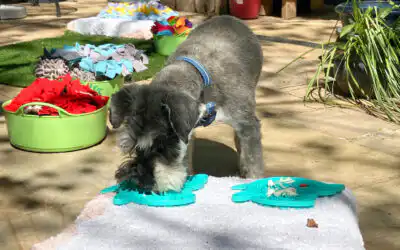
If you want to provide enrichment activities consider a Freework session or simply scatter feed their food in the garden or house and let them forage.
5 Ignore the Behaviour
Acknowledge that they are going through a fear period and it is a just a stage. With the right guidance and environmental management from you they will get through this.
If you are really worried, that your dog doesn’t seem to be coping or making progress it may be worth speaking to your vet and ask if it is worth considering medication or supplements to help on a short-term basis.
How Long is a Teenage Dog Fearful?
Adolescent fear periods can be more complex than a puppy fear period, which normally resolves in weeks.
With a teenage dog you may experience fear in cycles. Your dog may be fine one week, then a few weeks of being fearful and then the fear subsides, only for it to repeat again.
Hormones can prolong it. The development that is taking place in the brain and the sexual maturity mean there are a lot of complex changes impacting your teenage dog.
Mishandling a fear period can extend it, which is why it is so important to help your dog through this period.
If you would like to learn more about this subject, I’d thoroughly recommend Zazie Todd’s excellent book Bark!
Ready to Support Your Teenage Dog?
If you’re struggling with an adolescent dog who is fearful and is struggling to cope, and finding life a little overwhelming, personalised support can help.
Together, we can create a tailored plan that balances sleep, exercise, enrichment and relaxation—helping your teenage dog grow into a happy, confident and well-adjusted adult.
Ultimately, understanding how to help your fearful teenage dog will help develop a stronger bond between you and your dog.